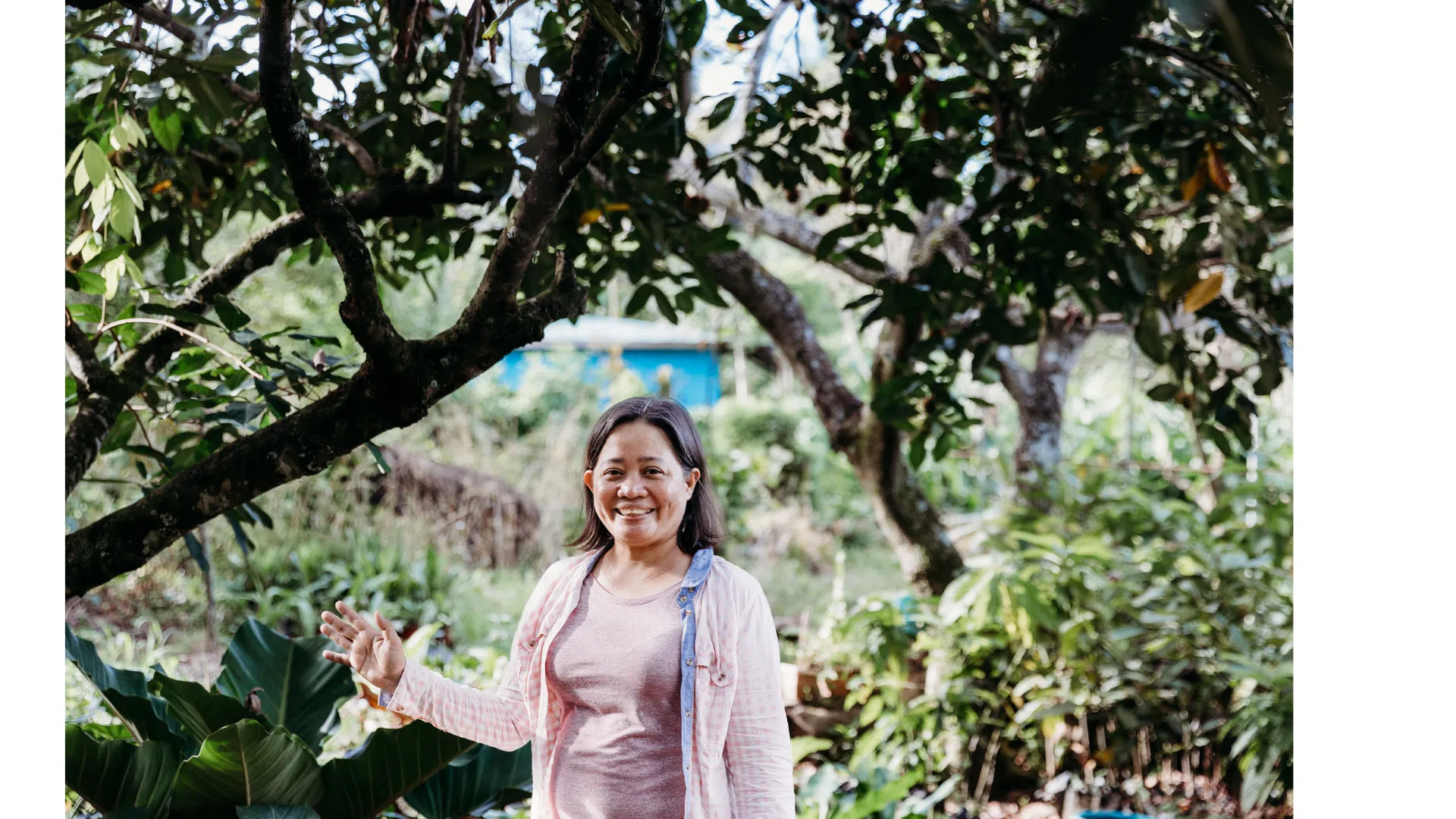
Photo Credit: Michelle Johnsen Photography |Mary Grace Belviz is the founder of Rosario's Delicacies in the Philippines
Climate Action & Resilient Communities · Feb 02, 2026
Rooted in Resilience: How Rosario’s Delicacies Transformed Challenges into a Blueprint for Inclusive Cacao Processing
For years, Mary Grace Belviz carried Rosario’s Delicacies on her shoulders alone. Every decision, from crafting new chocolate formulations to managing...
For years, Mary Grace Belviz carried Rosario’s Delicacies on her shoulders alone. Every decision, from crafting new chocolate formulations to managing finances and marketing, flowed through one person. Her determination built one of Davao’s – and the Philippines’ – most beloved cacao brands, but as orders grew and opportunities multiplied, the weight of running it alone became unsustainable. The business had reached an invisible ceiling, and Mary Grace knew something had to change.
“I think the real sign that a business is growing is when the owner can step back from day-to-day firefighting and focus on strategy — and on taking care of themselves,” says Mary Grace. “When they’re able to delegate operations and free up time to think, lead, and plan ahead, it shows the business is becoming more resilient and ready to grow.”
When passion meets its limits
Before connecting with the Resilience and Inclusion through Investment for Sustainable Agrikultura (RIISA) project, implemented by MEDA and funded by the Government of Canada, Rosario’s was thriving in reputation but fragile in structure. The company’s manual production process for chocolate-coated products was labour-intensive and limiting. Without efficient processing technology, meeting growing demand was a challenge.
Behind the scenes, governance systems remained informal with no structured Human Resources policies, no business continuity plan, and no clear succession strategy. The enterprise’s success depended entirely on Mary Grace’s continued presence and energy.
Rosario’s also had strong potential with its inclusive employment approach. Strawberry, a young woman with a disability and a member of the Bagobo Clata indigenous group, has been employed by Rosario’s for a decade, providing her with dignified work in a context where opportunities for persons with disabilities are scarce. Yet as the business struggled to scale, so did its ability to create more opportunities like hers.
A partnership built on possibility
The RIISA project saw what Mary Grace intuitively knew: Rosario’s needed more than capital. It needed systems, structure, and shared leadership that could outlast any single person.
In February 2025, a matching grant was provided through the RIISA project that enabled Rosario’s to acquire a chocolate panning machine. The technology would prove transformative in unexpected ways. It allowed Rosario’s to launch an entirely new product line of chocolate dragées made from jackfruit, durian, and marang. But even more importantly, it opened more doors for inclusion. The equipment was designed to be operated easily by women and persons with disabilities, turning automation into opportunity rather than replacement.
Today, young indigenous employees like Strawberry run the machine with precision and pride. Their leadership symbolizes Rosario’s belief that inclusivity is not an add-on, but a driver of innovation.