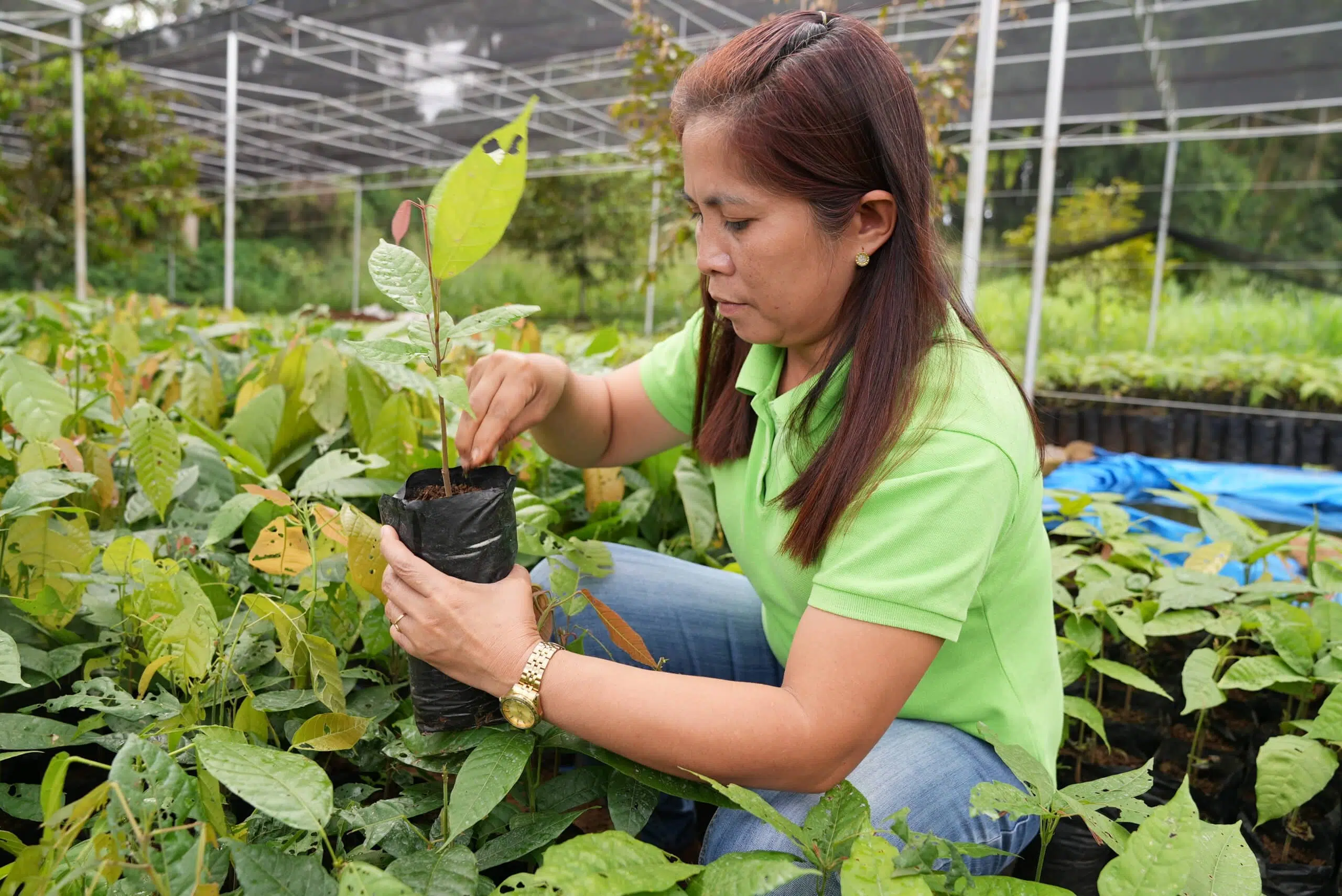
Photo Credit: MEDA |Marites A. Tabuac is part of the team of women who operates a nursery in Cadalian.
Economies & Decent Work · Feb 02, 2026
Small Plants Powering a Big Future in the Philippines
Few areas on Earth have the mix of sunshine, rainfall, high temperatures, and seasonal weather patterns as the island of Mindanao, Philippines. Six hu...
Few areas on Earth have the mix of sunshine, rainfall, high temperatures, and seasonal weather patterns as the island of Mindanao, Philippines. Six hundred miles south of Manila, its largest city, Davao City, is on its way to becoming a powerhouse in the global chocolate industry.
But before anyone can harvest the cacao that creates chocolate, someone needs to grow the plants.
In a Mindanao village called Cadalian, under a mesh canopy filtering the rays of an equatorial sun, thousands of small, green cacao seedlings reach toward the light. Each one is a potential engine of economic growth for the women who tend to their physical growth.
The nursery operates through a strategic partnership between the FARDECO Agricultural Multipurpose Cooperative (FARDECO AMPC) and MEDA’s Resilience and Inclusion through Investment for Sustainable Agrikultura (RIISA) project, funded by the Government of Canada. Together, they’ve created a business model that addresses both a growing demand for quality seedlings and the need for increased employment in rural Davao.
The nursery’s grafted seedlings are in high demand. They produce higher yields and better quality beans than conventional seedlings, helping strengthen Davao’s position as a premium cacao producer. Since 2017, Davao cacao has been ranked among the top 50 in global quality competitions, creating expanding market opportunities.
For Marites A. Tabuac, the nursery represents a transformation in how women participate in local economies. A mother who previously relied on seasonal farm work, she now has more control over her finances as part of the team of women who operates the nursery.
“Here, it’s us women who do the work because we are good at it—our hands are careful with the seedlings,” Marites says, inspecting newly sprouted plants. She’s part of the process that involves grafting, which combines a universal rootstock with stems of high-yielding varieties. Each properly grafted seedling increases a farmer’s potential yield, and the seedlings, once grafted, are sold at a profit.
Mary Jane Bulac is a cacao farmer and single mother who cares for her family as the primary breadwinner. She says the flexible nature of the nursery work fits in well with her schedule and allows her a steady income that supplements the family’s budget.
“It’s not hard work, because you just put the seedling in the soil after grafting, and after watching and watering it for six months you can sell it. It’s convenient because you can (also) work on other things if you want. This is extra income . . . extra income that (improves) the health of the family.”
– Mary Jane Bulac
MEDA’s approach through RIISA highlights the power of co-creating opportunities to increase economic activity while advancing sustainable agricultural practices. Rather than directing operations, MEDA provided critical capacity building, including technical training in seedling propagation, organic farming inputs, and market connections. The RIISA project also facilitated relationships with the Department of Agriculture and Department of Environment and Natural Resources, creating a supportive ecosystem for growth.
The nursery’s impact extends beyond its current operations. FARDECO plans to expand production next year and is exploring direct relationships with chocolate manufacturers seeking premium beans. The cooperative is also training more women in grafting techniques, creating specialized skills that command higher wages.
For the women of Barangay Cadalian, every seedling represents not just income today, but investments in tomorrow. In the Philippine cacao industry, where women have traditionally been on the sidelines, the FARDECO nursery demonstrates how women-led agricultural enterprises can become economic anchors for entire communities, one carefully cultivated seedling at a time.